Like Julius Rosenwald, Charles S. Johnson is not well-remembered, despite his major impact on the social landscape of the United States. A towering figure of the Harlem Renaissance, Johnson was a pioneer in nurturing African American excellence. Raised in the Jim Crow South, he was a lifelong advocate for racial equality and a scholar and activist who understood the power of art and education to reshape the nation.
Born in 1893 in Bristol, Virginia, to educated parents, Johnson attended Virginia Union University and then the University of Chicago, where he studied the relatively new field of sociology. After serving as a non-commissioned officer in the U.S. Army during the first World War, he completed his doctorate and moved from Chicago to New York to become the founding editor of the National Urban League’s publication Opportunity: A Journal of Negro Life.
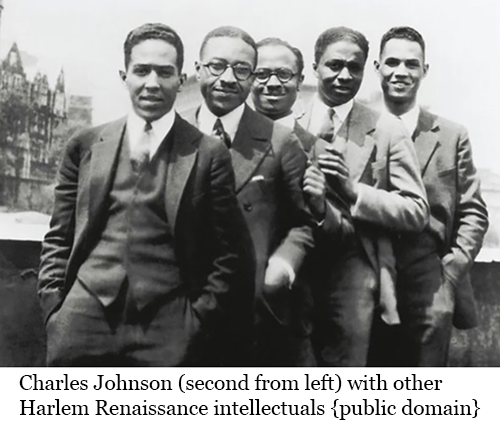
It was in this capacity that Johnson made a critical observation: the arts offered fewer barriers to African American success than other professional fields. In March 1924, he and Alain Locke, a widely respected writer and the first African American to win a Rhodes scholarship, organized and hosted an elegant dinner at the Civic Club in New York (the only space of its kind that would admit both white and Black guests). They invited 100 African American writers and artists as well as white editors, publishers, and scholars.
As a direct result of the dinner, Harper’s Magazine published Countee Cullen’s poems, and an issue of Survey Magazine was dedicated to works by the “New Negro.”
A year later, Johnson arranged the first of what became annual contests for African American writers of short stories, essays, poetry, and plays. The artists and writers who came together for the contest contributed significantly to the “Harlem Renaissance,” sharing a dedication to art that made a point. Whether through fiery didacticism or the “sheer humanness and beauty of their own story,” as Johnson called it, the members of the Harlem Renaissance insisted that their art serve as a front in the fight for racial equality.
As a result of his activities and leadership, Johnson became known as the “entrepreneur” of the Harlem Renaissance.
In 1928, Johnson became the chairman of Fisk University’s Department of Sociology. Two years later, he was awarded a Rosenwald fellowship to further his sociological research. The result was In the Shadow of the Plantation, published in 1934. A study of Alabama’s “Black Belt” that tracked the lingering effects of economic and social inequality on 162 families, it used empirical data to understand quality of life—specifically health conditions, poverty, and family structure—for African Americans in the South and firmly established Johnson as an expert in race relations.
Johnson became the president of Fisk in 1946, the first African American to lead the historically Black university. His leadership attracted painter Aaron Douglas, who became chairman of the Fisk Art Department, and Arna Bontemps, who became the school’s head librarian. Both men had also been Rosenwald Fund Fellows.
Johnson also contributed to the Brown v Board of Education case. His The Negro in American Civilization (1930) was cited three times in Part I of the NAACP brief. And he served as a reviewer of the ongoing work for the brief.
In 1955, Charles Johnson was on his way to Louisville for a meeting of the Fisk Board of Directors when he died of a heart attack at the age of 63. He was a quiet man whose interests and abilities took him far and left a lasting mark on the country. Among his legacies is his grandson Jeh Johnson Jr., who served as Secretary of the Department of Homeland Security from 2013 to 2017. Charles S. Johnson was both the Entrepreneur of the Harlem Renaissance and a Renaissance Man.